Showing posts with label Spanish. Show all posts

Thursday, May 5, 2011

¡¡Cinco de Mayo!!

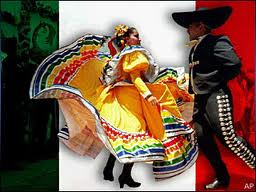
¡Feliz Cinco de Mayo y un saludo a todos!  Por favor, recurede que hoy no tiene que ver con la independencia mexicana (independencia de españa en 1810) sino que la guerra los franceses.  Entonces, cuando bebe la margarita y está comiendo las enchiladas, tacos, y flan, ¡Haga un saludo a la cultura mexicana!  ¡Qué buen día!


ok...and for those of you who looked above and thought..."Oh shit.  What language is that?" I shall translate:


Basically, Happy Cinco de Mayo!  And just in case you didn't know, NO, this holiday is NOT about Mexico gaining independence from Spain...no, no, and double no.  This holiday has to do with celebrating mexican culture as it pertains to the Mexican's fight against the french and Napoleon, the then dictator of Mexico.  So, while drinking on margaritas and chowing down on some well deserved tacos and enchiladas, salute the mexican culture and their incredible ability to stand up for themselves every 100 years.  :-)  ¡Olé!

Thursday, January 6, 2011

Kings Bearing Gifts

Happy Three Kings Day!! Or, as they say in Spanish, "Feliz día de los reyes magos".  :-)  


Yes, that's right, today, January 6, is the official day in which Christians celebrate "Epiphany," or the arrival of the Kings to the manger of baby Jesus (who, apparently was technically born today as well, fyi).  In olden days, before Santa made his debut and Christmas was moved to December 25th to fall in line with pagan holidays so that conversion to Christianity was easier, January 6th was the day for "Christmas" celebration.  Traditions vary greatly across hispanic cultures, but some include leaving piles of hay for the camels, receiving little trinket gifts or boxes of coal (hopefully you were good all last year!), or receiving all of your gifts on that day.  In fact, New York City has a Three Kings parade in East Harlem, which can be found on youtube if you so wish to check.


So, if you want another day of presents, are looking for a new tradition, or wanted to know when the official "12 days of Christmas" ended...it's today!  Enjoy!

Thursday, December 16, 2010

The Movement of Spanish Dance

This is more of a play on words if you will.  Yes, dancing, Spanish or otherwise, is movement, but I also mean the spread of its visibility across the world.  I've already talked to you a little about flamenco and the Spanish gypsy, but now I want to show you more.  More dancing!  More Spanish! ... olé!!!


I should probably thank DWTS (that's dancing with the stars for any non-viewer) for making ballroom dancing alone so popular, but for also shedding some light on some really great Spanish dances.  "Caribbean secrets" if you will, as many of the dances originated from that area.  Some of the ones I include in that statement are:  salsa, merengue, bachata, rumba, and cha-cha.  While each have slightly different backgrounds and have different varieties and "flavors" based on the actual country being discussed, the basic gist of their history is about the same.  Most of these originated from the Caribe" (Caribbean) as a mixture of Spanish, native, and African dances, which itself was a result of hundreds of years of slave trade, immigration, and colonization.  If that doesn't make sense to you, take a moment to watch the dances or listen to the music.  Most of them have similar sounds and beats, are happy and upbeat (rumba might be the exception as it's the 'slower' of the ones listed).  


However, do not make the mistake of thinking these dances are reserved for the ballroom!  If you haven't visited a latina-club before, and you like this kind of dancing, take yourself on an adventure!  They're fun, and way more casual / street dancing than what you'd find in your standard ballroom class, although basics are still basic, steps wise.  A good example?  The dance movie Dance with Me with Vanessa Williams and Chayanne.  The Club Azucar scene is great!  


But let's switch gears.  I have a new favorite dance to watch and try to learn.  TANGO.  That's right.  Tango!  Say it with me "T-A-NGO" (at least, that's what you have to keep saying to yourself as you learn the basic step...according to Antonio Banderas in Take the Lead.  In this movie, he shapes up a group of detention-hall banned kids via ballroom dance.  One dance, the dance he uses to capture their attention (*quick eyebrow raise*), is of course TANGO.  HOTT.  


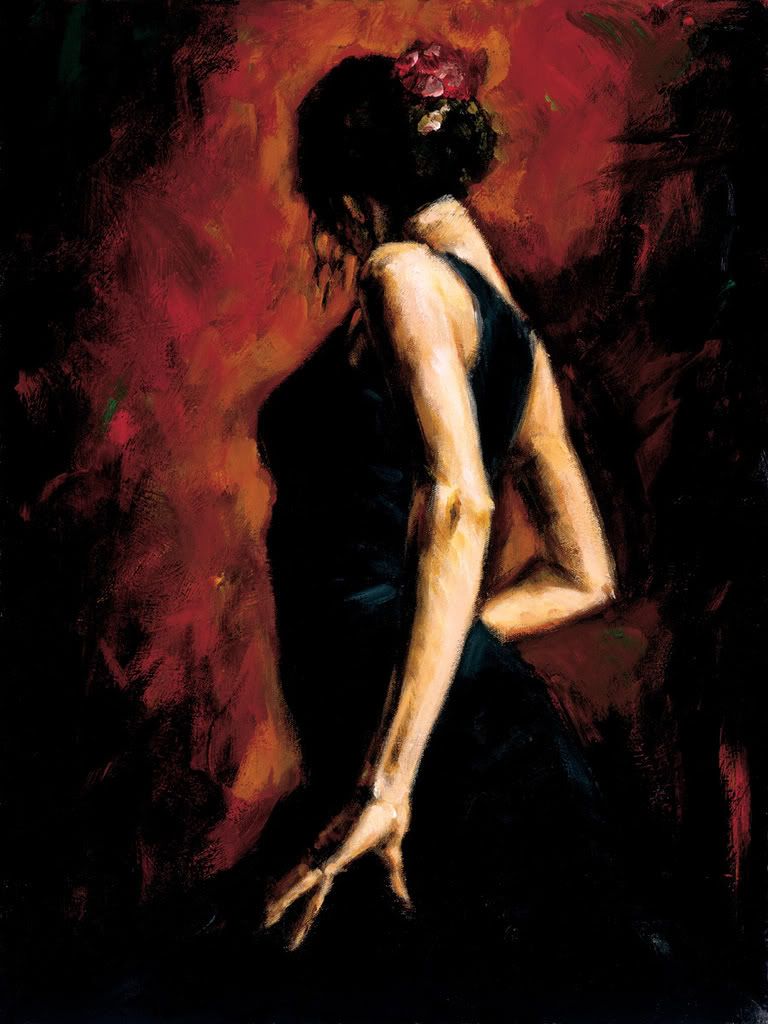
I love tango.  I love it because you put up one of these pictures like the one here by Fabian Perez, and by the position of the subjects alone people already know it's a tango. They look at it and, taking a quick gasp, go "ah! Tango!"  It originates in Argentina and is such a unique dance because there is so much involved.  It's not just a dance of love, but a dance of passion, lust, sex, jealousy, flirtation, and desire all wrapped up in one.  The movie, Moulin Rouge, did an awesome scene with it to the song "Roxanne".  I'm in love, but it kind of captivates that intense emotion and eerie air all at once.  The music is equally unique, often with violins, guitar, and sometimes piano, flute, etc, and it is popping up in all kinds of movies, besides just the ones listed above.  It's also been in: Scent of a Woman, Evita (as one would absolutely assume), Another Cinderella Story (with Selena Gomez), Shall We Dance, Out to Sea, Frida, and even True Lies.  


I think it's fair to say, dances certainly "get around".

Saturday, October 23, 2010

Dooms Day Oops?

I, like always, get my news from Yahoo news.  The other day, I came across an extremely interesting article regarding 2012, and the article said the Doomsday Prophecy might actually be wrong.  After initially laughing at the fact that this made news, I read further.


History first.  The Mayan calendar was divided into lots of different sections, and two of those sections included the "Long Count" and the "Short Count".  The Long Count and the Short Count are not explained in the ARTICLE, because, honestly, it's a grueling process to explain the logistics.  Basically the Mayans built a calendar based on a 52 year cycle with smaller measuring points in between . . . and there are LOTS of small measuring pieces.  Every 52 years is a new "Chapter" and when people refer to the Long Count they are usually referring to one of these cycles / chapters.  Additionally, everything is based on the lunar cycles not the solar ones, which is the opposite of how a lot of Western civilization functions, which is why it's complicated.


Ergo, the long and short of it is that "we" may have misinterpreted the Long Count specificity and may therefore be as far as 50 to 100 years off the actual "doomsday" date.  Fun, unless, of course, you're one of those people who has forgone all life savings to build a shelter and stock up for the worst, or one of those people who has run up all credit cards to "maximum" thinking it won't make a difference anyways in 2 years.  Otherwise, the rest of us can figure out if we want to "Party like its 2012" or just go about business as usual.

Wednesday, February 24, 2010

The "What-What"

Leave it to students.  You know, if it weren't for them I probably wouldn't be teaching.  They make my days worthwhile because they come up with some of the weirdest things to say.  It probably doesn't help that I have foreign language as my subject, which means all of the words they see are new words which need pronunciation practice, but still, they manage to find some new way to create comedy.


For example, Meet "Ñ" (en-yay), or the "n" with a tilde over it.  This is a famous Spanish character and is used in words like "niño" (little child), "baño" (bathroom), and montaña (mountain).  However, I've learned students don't actually like saying "tilde" and are semi-okay with saying the letter "ñ" (en-yay).  Sometimes I'll pull a Jeff Dunham and call the accent mark a "chik-a" and the tilde a "nya".  They seem to enjoy a short laugh as a result.  


However, my new favorite, is a gift from a student of mine the other day.  When saying "ñ" as I was spelling out the word for him in Spanish, he said "What?" and then proceeded to say "ooooh", and as he drew the tilde over the "n" he said "the what what".  Needless to say, I also said "What?" and furrowed my eyebrows and stared at him bewildered.  He had no idea he said it based on his blank stare and when I repeated his words laughter ensued.  Yay teenagers.


So, dear Jeff Dunham, if you could from now on insert the "what what" into your José Jalepeño on a Stick sketch it would be greatly appreciated.  Just be sure to give credit to my student!  :-)  Thank you Spanish language for giving us the "what what".  

Monday, January 25, 2010

Tale of Two Tongues

I love Spanish.  I teach Spanish.  I listen to music in Spanish.  I studied in Spain twice, and I  occasionally even dream in Spanish.  In short, I am obsessed with Spanish.  So when my job asked me to serve as a translator / interpreter for meetings and conferences for some of the Spanish families I, of course, jumped at the opportunity.  What a perfect way to continue using, practicing, and bettering my Spanish!

Today was one such day.  The conference wasn't long, which, as many of you may know, isn't always typical of conferences or meetings.  It was, however, concise, to the point, and informative.  And, in Spanish! . . . at least on my end.  I translated for the parent in the meeting, and had to translate back to the staff when the parent responded to comments.  To say it was a brain workout would be an understatement.  Just like with English, dialects and accents can vary greatly by region, making it difficult for the "outsider" to understand easily or instantaneously.  Case in point:  Take someone from the Bronx and stick them in rural Kentucky.  Or take a Texan and leave him in the most northern part of Minnesota.  Or, even better, take an American and sit him next to a Scottish person.  All the same language, all very different accents, and one very tiring conversation for both parties, due to the focus and attention required.  This, in short, was how I felt during my meeting.

Again, it was a wonderful experience, and great practice for me, especially being in a situation where different vocabulary is required from that of my standard classroom grind.  The icing on the cake?  The parent complimented me on my accent, noticing that it was Spanish (as I did study in Spain twice and have consequently picked up the infamous Spanish "lisp"), and that I was a wonderfully fluent speaker with a firm grasp on the language.  A gold star slapped across my forehead wouldn't have instilled as much pride and sense of accomplishment in me as this parent's comment.  I left the meeting feeling like my unexplainable love for the language held purpose.

It is rewarding to be complimented and commended for the talents we possess, especially when the talent and work lies in a true passion of ours, whether it be language in my case, or cooking or finance or art or rhetoric.  A compliment reinforces our efforts and hard work, and acts as a gold star on our heart.

For me, I hope this "Tale of Two Tongues" is only the beginning.  French and Italian are next on my list of languages to learn.  Who knows?  Maybe someday my love for language and traveling will lead somewhere.  For now, I am content to know that my passions made the difference to someone, even if it was just one "someone", and that I had the opportunity to continue to use my Spanish.  The point?  Unexplainable passions are there for a reason - we just have to figure out how we are meant to use them in our lives.

Tuesday, January 19, 2010

The soul of Andalusian gypsies

Flamenco,  the heart and south of southern Spain - Andalusia.  Or, as the natives say:  Andalucía. (an da lu THEE ah.....yes, this includes the famous Spanish "lisp")


This art form is not Sevillana - the dance with castenets (the finger "clankers" that most people associate with flamenco).  Flamenco, traditionally, is a gypsy dance performed with the music of the shoes and a guitar or drum.  There is usually a singer too who's voice is deep and raspy and the infamous Spanish guitar is right by his side.  It is just a drum in this video, but all of the above are traditional staples of the dance.  Not much is known about the true origins of flamenco, so I won't bother you with a history lesson.  However, my bone-deep passion for both Spanish and dancing makes this art form a high priority on my list.


In fact....fun fact...when I was lucky enough to study in Spain in college, I had the privilege of taking beginner flamenco classes.  When you watch this video you will realize what she does is far from easy.  Within 5 minutes my friends and I discovered arm and hand muscles we didn't know existed, and, while it may have only taken 5 minutes to create the pain, the pain hung around for a good 3 days.  


The footwork isn't a piece of cake either, but anyone who has danced before or done tap could pick it up quickly enough.  It's definitely a fun workout and hey, learning flamenco is a way to feel powerful and sexy all at the same time.  Win-Win!